
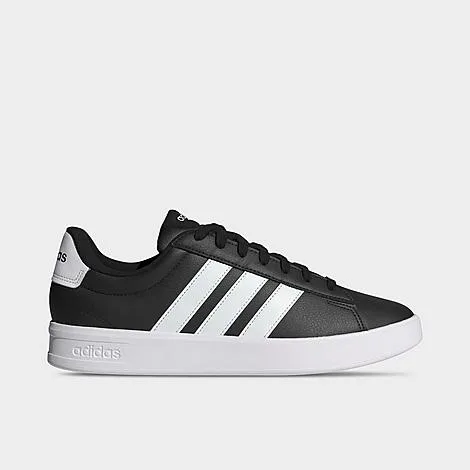
Adidas Men's Grand Court 3.0 Review
We may earn a commission from some links on this page.
The adidas Grand Court 3.0 is the brand's low court sneaker: a lace-up with a clean upper, a rubber cupsole and the three stripes at the side. It is a court-style shoe rather than a performance tennis shoe, and this review says so plainly up front. Here is what the shoe is for, how the fit usually runs, what to expect from a court sneaker at this level, and how to look after a pair.
Table of Contents
Key Takeaways
- The Grand Court 3.0 is adidas's low court sneaker, not a performance tennis shoe.
- It is a lace-up with a low-cut upper and a flat rubber cupsole.
- The shape is the reason it works with jeans, chinos and shorts as well as on court.
- Court sneakers of this kind are usually bought in your normal sneaker size.
- For actual tennis, you need a shoe with a reinforced upper and a hard-court outsole.
What the Grand Court 3.0 Is
The Grand Court is adidas's low court sneaker, and the 3.0 is the current version of it. It takes the shape of a tennis shoe and builds it as an everyday sneaker: a smooth upper, a lace-up front, a low collar and a flat cupsole with the stripes on the side.
That is a different brief from a tennis shoe. A shoe built for play has a reinforced toe for dragging, a sole pattern made for a specific court surface and a stiffer upper to hold the foot through a slide. The Grand Court has none of that. It is a court-style shoe, and it is honest about it: the low shape and the plain upper are the point.
What it does give you is the look. A black pair with a white sole is as neutral as a sneaker gets, and the low profile means it does not fight with trousers the way a chunky trainer does. It is the kind of shoe you wear to a casual office, out for the day or with shorts in summer.
Fit and Feel
Court sneakers like this are generally bought in your usual sneaker size. The lacing runs well down the front, so you can adjust through the midfoot, and the low collar sits below the ankle and keeps the shoe out of the way.
The fit is decided at the toe. Leave a little room in front of your longest toe without the heel lifting as you walk, and judge it with the socks you actually wear. A flat cupsole has very little spare depth, so if you plan to add an insole, try the shoe with it in place.
The upper is firm rather than soft when the shoe is new, which is normal for this style. It loosens a little as it creases across the toe, so a pair that feels snug rather than tight is the right starting point. If you are between sizes, the usual advice with a court shoe is to take the smaller one and let it give.
Detailed Features
The parts are the standard court-shoe set, and each one does a job:
| Feature | What it does |
|---|---|
| Low-cut upper | Keeps the shoe out of the way with trousers and shorts |
| Lace-up front | Lets you take up the fit through the middle of the foot |
| Rubber cupsole | The flat court sole, stitched and glued around the base of the upper |
| Three stripes | adidas's mark at the side of the shoe |
The cupsole is the part that shapes how the shoe feels. It is flat and firm, which is what gives a court sneaker its clean line, but it is not a cushioning sole: there is much less foam under the foot than in a running shoe, and long days on hard floors will tell you so.
Advantages and Disadvantages
The case for the Grand Court 3.0 is shape and simplicity. It is the entry point of the adidas court range, it goes with almost anything, and the plain upper is easy to keep clean. If you want one sneaker for jeans, shorts and the walk to work, this is the sort of shoe that does it.
The case against is the same flat sole. It gives little cushioning, and a court sneaker is not built to support a foot through a long run or a day of standing. The upper is also a simple one, so do not expect the materials of a premium pair at this level.
- Easy to wear: a low black or white court shoe suits most casual outfits.
- Simple shape: no chunky sole, so it sits under trousers cleanly.
- Entry point: the simplest way into the adidas court line.
- Flat underfoot: little cushioning for long days or long walks.
- Not for play: no tennis-specific support or outsole.
Court Shoe or Tennis Shoe?
This is the question that trips people up, so it is worth being clear. The Grand Court has the shape of a tennis shoe and none of the engineering. If you want to play, look at a shoe with a reinforced toe and a sole made for the surface you play on, such as the On The Roger Clubhouse Pro, which is sold as a tennis shoe.
If you want a court sneaker for everyday wear, the Grand Court is the right kind of shoe, and the adidas Advantage 2.0 is the other budget option in the same mould. Both are lifestyle shoes, and both should be bought for how they look and fit rather than for performance.
Care and Wear
A court sneaker is easy to look after, and a little routine keeps a light pair from going grey:
- Wipe dust off after a wear, before it works into the creases at the toe.
- Clean the upper with a sneaker cleaner on a cloth or soft brush, then wipe the residue off with a clean damp cloth.
- Scrub the rubber cupsole with a brush and soapy water when you clean the upper, so the white sole does not yellow with dirt.
- Keep the pair stuffed or on shoe trees between wears, and let a damp pair dry at room temperature, away from radiators.
Do not put a court sneaker in a washing machine. The heat and the tumbling break down the glue around the cupsole, and a pair that would have lasted years starts coming apart at the toe.
Add-ons for a Court Sneaker
Two things suit this shoe: an insole for the flat sole, and a cleaner for a light upper.
Frequently Asked Questions
Can You Play Tennis in the Grand Court?
It is not built for it. The Grand Court is a lifestyle court sneaker with no reinforced toe and no hard-court outsole, so it will not hold up to the dragging and sliding a match involves. Use a performance tennis shoe for play and keep this pair for everyday wear.
Do Grand Courts Run True to Size?
They are generally sold in your usual sneaker size. The toe is where the fit is decided: leave a little room in front of the longest toe and check that the heel stays put. Try them with the socks you wear and with any insole you plan to use.
Are They Good for Wide Feet?
A low court shoe is cut fairly close, so wide feet often need to go up half a size or look for a wide fit. check the listing for the widths the shop actually stocks before you order rather than guessing.
How Do You Clean Them?
Use a sneaker cleaner on the upper rather than household soap, work it in with a soft brush or cloth, and wipe it off with a clean damp cloth. Scrub the rubber cupsole separately with soapy water. Do not soak the shoe or machine wash it, and let it air dry away from direct heat.
How Does the Grand Court Compare to the Advantage?
They are close cousins: both are low adidas court sneakers at the entry end of the range. The Grand Court is the plainer, more minimal pair, while the Advantage adds a little more detail at the heel. Either is a lifestyle shoe, so pick the one whose look you prefer.